
We live in a world overflowing with bold claims—about consciousness, evolution, human potential, and artificial intelligence.
Some of these ideas are compelling. Some are inspiring.
But the question I’ve been sitting with lately is this: How do we know when something actually holds water—versus when it just sounds good?
Because not everything that sounds “reasonable” holds up under closer examination.
And that’s where discernment comes in.
The Seduction of a Great Story
I recently listened to a well-known podcast where the guest laid out a sweeping theory about human evolution and spiritual potential.
It sounded compelling.
He claimed that two specific genes had been “tinkered with” in our past, and that this was evidence we were designed for greatness—perhaps even divinity.
He positioned this “built-in spiritual potential” as the thing that would allow us to surpass artificial intelligence.
He framed heart coherence as the new enlightenment. And he offered a three-step shortcut to awakening.
And at first? It all sounded (somewhat) reasonable, seductive, even.
But the longer I listened, the more I noticed the glaring gaps.
The entire theory hinged on a single premise: that human genes were deliberately altered by some form of intelligence.
From there, everything else was extrapolated – our specialness, our spiritual potential, our ability to transcend AI.
The problem? The appearance of logical consistency doesn’t make something logically sound.
And that’s exactly why the premise deserves scrutiny.
This is where discernment matters.
Every solid theory depends on the strength of its foundational premise. If the premise is questionable—or worse, assumed to be true without sufficient support—then no matter how coherent the story seems, it doesn’t hold water.
Who supposedly did this? What kind of intelligence are we talking about here?
I’ve heard versions of this gene-manipulation idea before, most often in New Age circles, usually pointing toward some vague alien origin story (let’s be honest: this is basically Anunnaki with better branding).
And while the guest did offer some support for his claim, that only raised more questions.
• Where’s the hard scientific evidence?
• Who agrees with this, and what peer-reviewed evidence are they basing it on?
• What are the competing explanations?
• Why should we assume intelligent design instead of unknown evolutionary complexity?
When no one’s asking these questions, especially over the course of a three-hour conversation, it’s easy to mistake storytelling for truth.
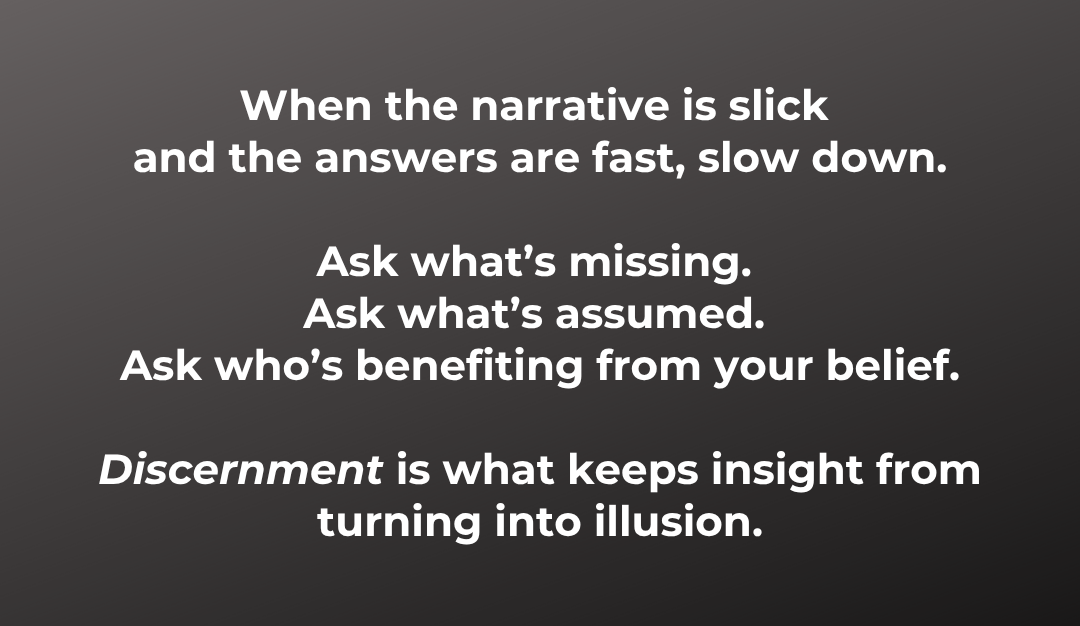
Discernment asks us to slow down, question the premise, and examine the logic—before we get swept into the narrative.
Why Discernment Matters
So why am I bringing this up?
Because in a time when complexity is rising and information is overwhelming, discernment has become one of our most essential human skills.
Not just in theory—but in our actual day-to-day interactions with ideas, teachers, methods, and practices.
According to the Oxford Dictionary, discernment is “the ability to judge well.”It’s the capacity to evaluate, analyze, and draw distinctions between things that may appear similar on the surface—but are vastly different underneath.
Discernment is what lets us recognize the difference between logical form and logical validity.
Just because something hangs together in a neat narrative doesn’t mean it holds water.
In fact, the tighter the package, the more important it is to pause and look for the glue.
When we don’t ask questions, we leave ourselves open to confusion, self-deception, and spiritual bypassing dressed up as revelation.
Discernment is the opposite of taking things at face value.
It’s not about how something feels in the moment. It’s about slowing down and asking better questions.
It’s about noticing what’s being glossed over—or what’s being claimed too confidently.
It’s the ability to pause and ask:
• Am I being pulled in by the delivery—or the substance?
• What assumptions am I being asked to accept without proof?
• Does this line up with what I know from experience, study, or deeper reflection?
• What would I need to see—or hear—to take this seriously?
• What perspectives are being left out?
• Is this conclusion actually supported by the data—or just emotionally satisfying?
But when we practice discernment, we’re not killing mystery—we’re protecting it from oversimplification.
And without it, we’re left vulnerable to whatever story makes the most emotional sense… even if that story bypasses real depth.
The Shortcut Problem
Which brings me to one of the most frustrating moments in that episode.
The guest suggested that heart coherence —three steps, five minutes —could replace decades of spiritual practice.
So, let’s talk about shortcuts.
They’re everywhere in wellness and spiritual circles. Often marketed as “ancient wisdom meets modern science.”
And they’re incredibly seductive—especially when they promise transformation without effort, or awakening without discomfort.
I get the appeal.
But when a technique is framed as a replacement for the kind of spiritual work that historically took years of disciplined inquiry, something in me pushes back.
Now, I’m certified in HeartMath. I’ve studied it. It works.
But let’s not confuse emotional regulation with enlightenment.
As a student of Buddhism and Kashmir Shaivism, I hold deep reverence for those who spent twenty or more years systematically exploring the nature of consciousness—layer by layer, shadow by shadow.
To equate that with a technique, even a good one, isn’t just inaccurate. It’s kind of disrespectful.
It’s not that I’m opposed to sudden transformation.
I love stories of awakening—Byron Katie, Eckhart Tolle, near-death experiences, deep insight sparked by psychedelics.
But those moments usually arrive after years of unconscious groundwork—or in the middle of immense rupture.
They’re earned, even if they seem spontaneous.
If heart coherence leads to full awakening, I would’ve loved to hear more about the speaker’s personal experience of that.
What changed? What fell away? What stayed?
But we didn’t get that story.
We got certainty without the struggle.
Discernment Is the Practice Beneath the Practice
In my own work, across psychophysiological training, subtle-body awareness, and applied change strategies, one thing has stayed consistent: Real change isn’t delivered in soundbites.
And truth isn’t something you download. It’s something you uncover through contact, clarity, and consistent inquiry.
Discernment isn’t the enemy of intuition.
It’s what gives intuition traction.
In a culture obsessed with hacks, claims, and spiritual marketing, discernment isn’t just a nice-to-have.
It’s a survival skill.
So let me leave you with a few questions:
• What’s one time you realized something sounded true—but didn’t hold up under scrutiny?
• Have you ever followed a teacher or method that seemed solid… until it wasn’t?
• What helps you catch the difference between a compelling story and real substance?
• Is there a belief or idea you’ve recently re-evaluated?
• When something feels “off,” what’s your first move—do you investigate or move on?
• What kind of “truth signals” do you trust—and how do you test them?