
Related Posts
How Intentional Living Became Another Hustle
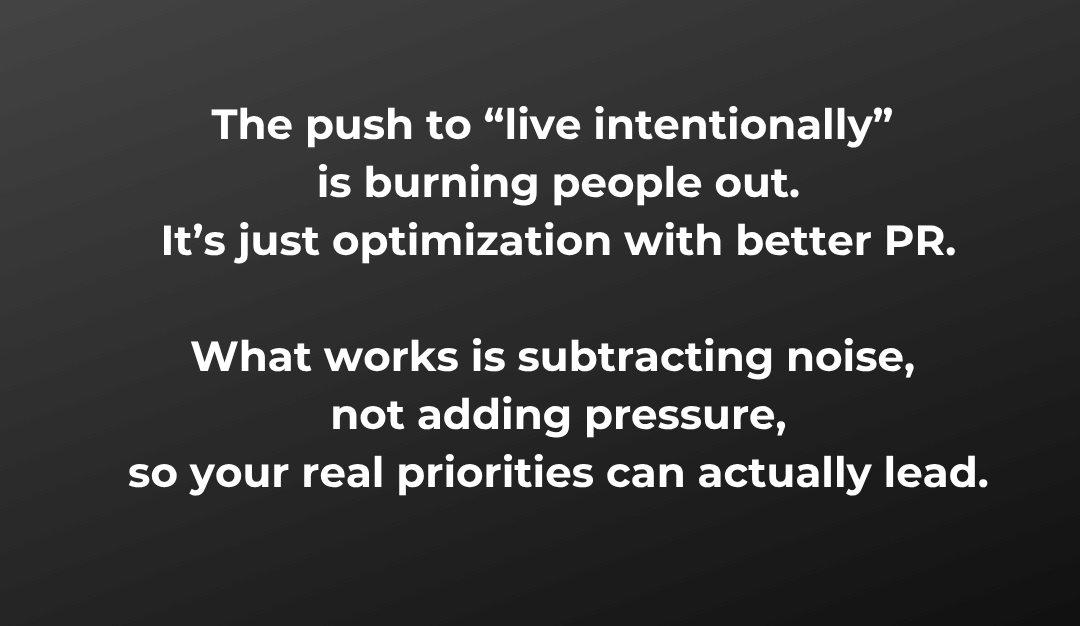
When Everything Is Intentional, Nothing Is
We live in an era where everything is branded as intentional. Your skincare routine. Your calendar app.Your playlist.
The word appears like a badge of depth, something that signals alignment, meaning, and clarity. But more often, it reveals the opposite.
When used for everything, “intention” reveals a watered-down version of our standing in the world and actually shows an uncertainty about our own direction.
A recent New York Times essay by Marie Solis asks, “When did everything become so intentional?” She points out how the word has become shorthand for meaning—used to describe nearly every activity, from working out to playing trivia, as if calling it intentional gives it value, importance, and status.
It’s almost like we’re trying to rescue every ordinary moment with a dose of “hey, look at me, I’m as intentionally performative as it gets.
Why?
In a world shaped by algorithms and driven by unpredictability, intention may simply function as a coping mechanism, reassuring us that we’re still relevant.
But here’s the problem.
Intention, used in this way, is a mental overlay. A desperation-laden effort. A corrective narrative.
And for all its popularity, it hardly reaches the part of us that actually needs meaningful action.
However, what lies beneath this obsession with intention is actually worth paying attention to.
Because it points to something real:
- A longing to feel like we’re living on purpose.
- A need to reclaim agency in a world that increasingly operates without us.
- A desire for alignment in a culture built on distraction.
That longing isn’t the problem. But how we go about answering it… is.
Why We Crave It
Let’s be honest—there’s a real hunger underneath all of this.
We want our lives to be guided by something other than momentum.
We want to feel like we’re making a choice. Not just reacting, performing, or drowning in micro-decisions.
But the mind’s idea of “intention” often makes the problem worse.
It adds more doing. More optimization. More performance.
You don’t need more intention. You need orientation.
What Yoga Offers Instead
And that orientation—the one that can’t be fabricated by thought—is what Yoga calls “sankalpa.”
If modern intention keeps us spinning in the realm of thought, Yoga offers something more essential.
Something beyond mindset hacks, superficial goals, or even something you craft with the thinking mind.
In Yoga, a true intention (Sankalpa)is a profound vow, a deep inner resolve that arises from clarity, not effort.
Here’s the thing: in Western self-development, “intention” usually means choosing a goal and focusing your attention to move toward it.
It’s a conscious effort — driven by willpower, clarity, or strategy.
But in Yoga, and more specifically in Yoga Nidra, sankalpa is not set by the conscious mind.
It’s not an idea, affirmation, or outcome.
It’s a vow that arises from the depths of consciousness — and it can’t be forced.
A true sankalpa doesn’t come from anxiety or from a desire to fix yourself. It comes from a moment of inner stillness, when clarity is already present.
You don’t come up with it — you remember it. You feel it.
It’s not about becoming something you’re not. It’s about realigning with what’s already true — underneath distraction, reactivity, and conditioning.
“Rather than trying to control or improve life, sankalpa awakens the inherent intelligence of life itself — the will that already exists within you.”
It may sound simple — but it’s a radical departure from how most of us approach change.
How Yoga Nidra works with Sankalpa.
The place where sankalpa is most potent, where it actually takes root, is through the practice of Yoga Nidra.
Yoga Nidra is described as “yogic sleep.”But it’s not sleep or even meditation in the usual sense. It’s a guided experience that induces a profound state of rest, in which the body becomes completely still, and the thinking mind becomes quiet, yet actively alert.
This is a different kind of awareness, not analytical or conceptual, but open, sensitive, and receptive.
In fact, it could be said that the main purpose of Yoga Nidra is to realize one’s sankalpa.
In this state of least resistance, you plant your sankalpa directly, a clear, embodied vow that takes root beneath the surface of the mind.
This is where sankalpa works—because the conditions are right.
You’re no longer trying to improve or control life. You’re no longer reinforcing your surface identity.
You are creating the conditions for something much deeper to grow.
“The main success of the sankalpa comes when the seed produces its fruit in its own time. After the sankalpa is made, the mind nurtures it at deeper levels of the body and psyche.”
—Swami Shankardevananda Saraswati
A sankalpa doesn’t push.
It pulls you into coherence.
It shifts the organizing principle, not just the behavior.
That’s why it works—not as a tactic, but as a turning point.
Setting Your Sankalpa
In Yoga Nidra, the sankalpa is not chosen by the thinking mind. It emerges from the stillness beneath your patterns. The place where conflicting voices go quiet. Where effort dissolves. Where you can hear yourself—without distortion.
Here’s what makes a sankalpa powerful:
* It’s simple. A short, positive statement, stated in the present tense. Not a wish or a hope, but a vow that affirms what already wants to move through you. (e.g., “I live with clarity.” or “I trust my inner guidance.”)
* It’s aligned. Not with your ego’s plans, but with a deeper current, what Yoga calls iccha shakti, the innate will of consciousness.
* This is not about fixing yourself. It’s about resonating with what’s already whole.
* It’s repeated—at the right moment.
Sankalpa isn’t meant to be recited like a mantra all day long. It’s planted in the fertile state of Yoga Nidra—where the body is still, the mind is quiet, and the subconscious is receptive.
Once received in that state, the sankalpa works like a seed: quietly, steadily, beneath the surface.
As Swami Shankardevananda wrote:
“A resolve or sankalpa is made during the practice of Yoga Nidra… a resolve that brings your whole being into harmony and directs your energies toward a single purpose. Once this vow is heard by every level of your being—the body, the mind, the heart—it begins to move life in that direction.”
Personal Reflection
When I first began working with my sankalpa, it was anything but clear.
My early versions were long, run-on sentences that tried to include everything I cared about, as if leaving something out would make it less accurate.
It took time and many rounds of practice to realize that my need for precision was actually a form of perfectionism, the part of me that believed clarity required control.
Over time, the vow simplified itself.
Nine words.
And in that simplicity, something opened.
Working with an intention revealed the patterns that obscured it.
I began to notice where I tighten, overthink, or try to get it “right.”
This practice didn’t just clarify my focus; it exposed everything that stood in the way of it.
As I’ve continued to work with my present sankalpa, life has reorganized around it in quiet, unexpected ways.
Synchronicities have shown up, nudging me away from psychotherapy and toward the somatic, energetic work that feels truer.
In my own practice, this shift has released layers of physical holding. Sometimes it moves me to tears—old emotion leaving the body without a name.
I can’t say where this process is taking me, only that it’s making things simpler. I spend more time on the mat. More time listening. Less time seeking distraction.
I’m not cut off from the world; I just meet it differently—through a steadier mind and a quieter nervous system.
Set Your Own Intention
If you’d like to explore your own deeper intention, here are a few questions to reflect on:
• What do I want my life to be about — beneath the goals, habits, and daily to-do list?
• What matters more to me than success, comfort, or approval?
• What unique gift or presence could I offer that would serve life itself?
• Who am I when I stop striving to improve myself and simply remember who I am?
• What is the felt sense in my body when I imagine living in full alignment?
Don’t overthink it. Let the words arise naturally. You’re not making a declaration — you’re listening for the quiet signal already pulsing underneath.
Let your response be a seed. Then, return to it. Water it. Let it grow.
Final Synthesis
The modern craving for “intention” is valid. We want to live with purpose, to make choices that matter, to resist the pull of chaos. But what we call intention is often another form of control, a way to soothe the discomfort of not knowing.
Sankalpa invites a different relationship: one of listening, remembering, and returning.
It’s not about achieving; it’s about orienting toward the truth of who you already are. And when planted in the fertile stillness of Yoga Nidra, it doesn’t just change your mindset. It begins to re-pattern your system from the inside out.